History of Westlands, Nairobi: From Kirungii Hill to a Modern Real Estate Hub
Westlands today is one of Nairobi’s most recognisable commercial and residential districts — a place of high-rise apartments, Grade A offices, international hotels, shopping malls, restaurants and increasingly dense urban development. But the Westlands skyline is a relatively recent phenomenon.
The neighbourhood’s story is one of gradual transformation: from a landscape on the western edge of early Nairobi, through a low-density residential phase, into a commercial district and, eventually, one of the city's most important mixed-use property markets.
Understanding the history of Westlands also helps explain why property values, apartment developments and commercial buildings have concentrated here.
Before Modern Westlands: The Landscape Before Development
Before Nairobi became the city we know today, the area that would eventually become Westlands was part of a much less urban landscape.
Local historical accounts describe the area as a hill known as Kirungii Hill, while the wider western side of Nairobi was connected to routes and settlements beyond the developing railway town. (Karibu Nairobi)
Nairobi itself changed dramatically after the arrival of the Kenya-Uganda Railway, which reached Nairobi in 1899 and helped establish the town as a transport, administrative and commercial centre. Academic research on Nairobi's early land-use history notes that settlers were already establishing themselves around areas such as Kabete and Westlands during the early development of the city. (UON eRepository)
Westlands was therefore never simply an isolated modern suburb. Its eventual growth was connected to Nairobi's westward expansion and its road and railway connections to the wider hinterland.
Colonial Nairobi and the Emergence of Westlands
The modern identity of Westlands began taking shape during the colonial period as Nairobi expanded beyond its original core.
A local historical account records that Parklands was formally developed as a residential area for civil servants during the 1940s, after which population pressure encouraged expansion westward toward the Waiyaki Way corridor. (Karibu Nairobi)
This helps explain an important feature of Westlands today:
It did not begin as a commercial district.
For much of its earlier development, it was associated with relatively low-density residential occupation, gardens, homes and suburban space.
That character would gradually change as Nairobi's population grew and the city became increasingly dependent on additional commercial centres outside the CBD.
From Nairobi Suburb to Commercial Centre
The major transformation began as Nairobi outgrew its traditional Central Business District.
By the late 20th century, businesses increasingly needed larger and more modern premises, better parking and easier access to Nairobi's growing residential population. Research on Westlands identifies the late 1970s, 1980s and 1990s as an important period in its transition toward a secondary commercial centre, as private investment expanded office and commercial development. (Our Kenya)
The geography helped.
Westlands sits only a few kilometres northwest of Nairobi CBD and is connected to major roads including Waiyaki Way, making it a natural stopping point between the central city and Nairobi's western and northern suburbs. (BuyRentKenya)
As more offices arrived, the demand for everything around those offices followed.
Restaurants.
Banks.
Hotels.
Retail.
Entertainment.
Apartments.
The foundations of modern Westlands were being established.
1983: The Arrival of Sarit Centre
Few developments changed Westlands as profoundly as Sarit Centre.
Construction began in 1981, and the shopping centre opened in April 1983. It was Kenya's first modern enclosed shopping mall and initially opened with just two tenants: Uchumi Supermarket and Text Book Centre. (kenyanartsreview.blogspot.com)
The concept itself was ambitious.
The developers had encountered the emerging enclosed shopping-centre model abroad and sought to introduce something similar to Nairobi. What started as an unusual concept soon became an important commercial destination.
By the mid-1980s, Sarit Centre had become firmly established, and its later expansions introduced additional retail, entertainment and exhibition functions. In the 1990s, plans for a second phase included a cinema, food court, gym and exhibition facilities, reflecting how the shopping centre was evolving beyond simple retail. (kenyanartsreview.blogspot.com)
The importance of Sarit was much larger than the building itself.
It helped establish Westlands as somewhere Nairobi residents went to shop, socialise, work and spend time.
That made the surrounding land more commercially useful.
And as commercial activity increased, residential demand followed.
The Mall and the Expansion of Modern Retail
Sarit was not the end of Westlands' retail story.
The Mall was built in Westlands in 1990, adding another organised retail destination to the neighbourhood. Its later history also illustrates how established retail spaces can evolve as consumer behaviour changes. (The Irish Times)
The 1990s and early 2000s therefore marked a period in which Westlands developed an increasingly recognisable combination:
Homes + offices + retail + hospitality + entertainment.
That combination is one of the reasons the neighbourhood eventually developed into something very different from a conventional residential suburb.
The 1990s and Early 2000s: Businesses Move West
As Nairobi's CBD became increasingly constrained by congestion and limited space, Westlands became one of the locations capable of absorbing new commercial activity.
By the 1990s and early 2000s, more businesses were relocating from the CBD toward Westlands and Upper Hill, where newer buildings and comparatively greater availability of land and office space offered an alternative to the traditional city centre. (BuyRentKenya)
This period is crucial to understanding Westlands real estate.
The development of offices created employment.
Employment created demand for housing.
Housing created demand for retail and services.
Retail created further commercial activity.
Westlands began functioning as an increasingly self-contained urban district.
2007: Westgate Adds Another Major Retail Landmark
The next major milestone came with Westgate Shopping Mall, which opened in 2007 on Mwanzi Road.
The five-storey mall introduced roughly 350,000 square feet of retail space and more than 90 stores at opening, with major tenants including Nakumatt and Planet Media Cinemas. (Wikipedia)
Westgate strengthened the idea that Westlands was not simply an office district.
It was becoming a lifestyle destination.
People could work in Westlands, live nearby, shop nearby, eat nearby and spend their leisure time within the same broad urban environment.
That model would later become even more pronounced through mixed-use developments.
2010s: Westlands Starts Building Upward
During the 2010s, Westlands' transformation became increasingly visible in its skyline.
New Grade A office buildings began appearing along major corridors, including One Africa Place, which was completed in 2018. (Sutherland Engineers)
Commercial development expanded further through projects such as Sanlam Tower, completed in 2018, as well as the broader pipeline of office and mixed-use developments along Waiyaki Way and throughout the district. (Estate Intel)
This period marked a decisive shift from the old low-rise suburban image.
Westlands was becoming vertical.
Land that once supported relatively low-density buildings increasingly became valuable for multi-storey offices, apartments, hotels and mixed-use developments.
GTC Changed the Westlands Skyline Again
One of the most visible developments in this transformation was the Global Trade Centre (GTC).
The complex opened its doors in December 2021 and comprises six towers, including the 42-storey GTC Tower, alongside retail, hospitality and residential components. Nairobi City County describes the tower as rising approximately 604 feet and identifies facilities including a mall and the Pan Pacific serviced suites within the complex. (Nairobi County Government)
The development represented something bigger than another office tower.
It demonstrated the evolution of Westlands toward the mixed-use city model:
Work
Live
Shop
Stay
Meet
all within one connected development.
This model has since become increasingly visible across Nairobi's new real estate projects.
2022: The Nairobi Expressway Connects Westlands Even More Directly
Infrastructure has been another major force in Westlands' transformation.
The 27.1-kilometre Nairobi Expressway connects Mlolongo through Nairobi CBD to the James Gichuru Road junction along Waiyaki Way, with Westlands forming its western terminus. KeNHA identifies Westlands and James Gichuru among the expressway's interchanges. (Kenya National Highways Authority)
The road opened for public use on 14 May 2022. (Citizen)
This created another important piece of infrastructure for Westlands.
The neighbourhood was no longer simply a destination on the western side of Nairobi.
It became a major endpoint on one of the city's most important east-west transport corridors.
For businesses, residents and visitors, connectivity became an increasingly important part of the Westlands proposition.
From Malls to Mixed-Use Developments
The evolution of Westlands can therefore be viewed through its commercial landmarks.
First came the modern shopping-centre concept
Sarit Centre — 1983
Then came additional retail
The Mall — 1990
Then a new generation of lifestyle retail
Westgate — 2007
Then large office and mixed-use developments
One Africa Place, Sanlam Tower and other office projects
Then large-scale integrated developments
GTC — opened 2021
And then stronger highway connectivity
Nairobi Expressway — 2022
This progression explains much of what you see in Westlands today.
The neighbourhood's transformation wasn't caused by apartments alone.
Retail attracted people. Offices attracted workers. Infrastructure improved access. Hotels supported business and tourism. Apartments housed the growing population.
Each layer reinforced the others.
Westlands Today: A Different Nairobi
In 2026, Westlands is no longer easily described as either a suburb or a business district.
It is a mixed-use urban centre combining:
Residential apartments
Grade A offices
Shopping malls
Hotels
Restaurants
Entertainment
Healthcare
Corporate headquarters
Serviced residences
High-rise developments
The modern Westlands skyline reflects decades of accumulated investment.
Recent property research continues to describe the district as one of Nairobi's major commercial and residential centres, while the 2026 market continues to see new apartment and mixed-use projects entering the area. (Property Finder KE)
The Apartment Boom
One of the most obvious consequences of Westlands' transformation has been the rise of apartment living.
As land became more valuable and demand for centrally located housing increased, developers increasingly moved vertically.
Instead of one house occupying a large parcel, the same land could support:
Dozens or even hundreds of apartments
alongside parking, gyms, swimming pools, restaurants, retail and other shared facilities.
This helps explain why modern apartments for sale in Westlands range from compact studios and one-bedroom homes to large three-bedroom apartments, penthouses and luxury residences.
It also explains why Westlands today looks dramatically different from the low-density neighbourhood that existed several decades ago.
Westlands Has Also Expanded Its Definition of Luxury
Luxury property in Westlands used to be associated largely with location and large office or residential spaces.
Modern developments have changed the equation.
Today, developers increasingly compete through:
Rooftop swimming pools
Sky lounges
Gyms
Concierge-style lobbies
Restaurants
Smart-home systems
High-speed elevators
Business centres
Residents' lounges
Entertainment facilities
The development itself increasingly functions as an ecosystem.
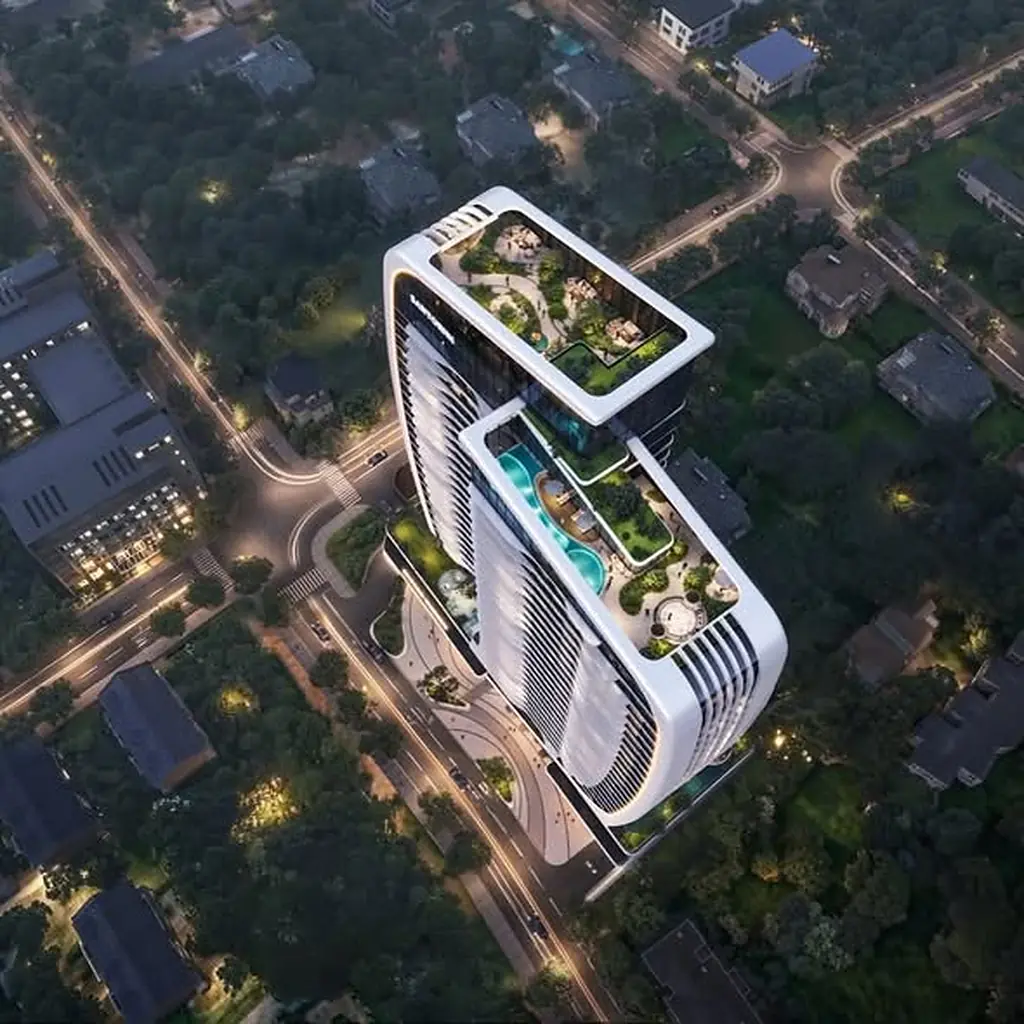
This is visible in newer Westlands properties such as Santorini Residences, where residential units are integrated with retail, hospitality-style spaces and extensive shared amenities.
The Cost of Success: Density and Infrastructure Pressure
Westlands' transformation has not been without challenges.
The rapid growth of commercial and residential buildings has placed pressure on roads, drainage, parking and other infrastructure.
A 2026 analysis by Business Daily describes the district as having moved from its original low-density vision toward a much denser commercial and residential environment, with increasing traffic and pressure on infrastructure. (Business Daily Africa)
Earlier academic research into Nairobi's densification also identified Westlands and neighbouring areas as locations where development had outpaced the ability of infrastructure planning to keep up with demand. (UON eRepository)
This is an important part of the history.
Urban growth creates both opportunity and pressure.
Westlands' success has made the district more valuable and more connected, but also more intensely developed.
Why the History Matters for Westlands Property
The history of Westlands helps explain the neighbourhood's current real estate structure.
Its location encouraged early outward growth.
Its connection to Waiyaki Way supported accessibility.
Sarit Centre established organised modern retail.
Office development brought businesses and employment.
Westgate reinforced lifestyle and retail demand.
Major towers increased commercial density.
The Expressway strengthened regional connectivity.
Apartment development responded to the growing population and value of centrally located land.
The result is today's Westlands:
a place where residential, commercial, retail and hospitality property increasingly exist side by side.
From Westlands' Past to Its Future
The next chapter of Westlands is unlikely to resemble its past.
The neighbourhood has already moved through several distinct stages:
Open landscape
?
Low-density residential area
?
Suburban commercial centre
?
Office and retail destination
?
High-rise mixed-use district
?
Major urban business and residential hub
And the transformation is still underway.
The continued appearance of new apartments, serviced residences, offices and mixed-use developments suggests that Westlands is becoming increasingly vertical and increasingly integrated.
The challenge will be balancing this development with the infrastructure, roads and public services needed to support a much denser urban population.
Westlands: A Real Estate History Written in Buildings
Perhaps the easiest way to understand the history of Westlands is simply to look at its buildings.
Sarit Centre tells the story of modern retail.
Westgate tells the story of lifestyle-driven commercial development.
One Africa Place and Sanlam Tower represent the rise of Grade A offices.
GTC represents the arrival of large-scale mixed-use development.
The growing apartment skyline reflects the rising value of residential land and demand for urban living.
And the Nairobi Expressway represents the infrastructure connecting this increasingly important district to the rest of the city.
What looks today like a fully formed urban centre is actually the result of more than a century of Nairobi's westward growth and several decades of increasingly intensive investment.
Explore Westlands Property Today
For buyers interested in experiencing the modern side of the neighbourhood, explore apartments for sale in Westlands through Homesphere Kenya.
You can also compare specific developments, including Capital Aura Westlands and Diplomat Residencies.
For a broader view of how Westlands fits into Nairobi's changing property market, read Nairobi Property Market 2026: Where to Buy & Invest.
Our guide What Does KSh 5 Million Buy in Nairobi in 2026? is useful for buyers exploring entry-level property, while What Does KSh 10 Million Buy in Nairobi in 2026? looks at the next stage of the market.
For prospective buyers, our first-time property ownership guide explains the ownership, due-diligence and registration process.
Homesphere Kenya — Be Smarter than your Sources.
Historical information in this article draws on academic research, historical accounts and documented development timelines. Some early-history details are based on local historical accounts where archival material is limited. Current development and infrastructure references reflect information available through September 2026.